Learn how to keep critical facilities running with zero unplanned interruptions using world-class Swagelok® products.


Fabricators, assemblers, engineers and maintenance professionals, we invite you to take advantage of Swagelok's training and education programs. These certificate-granting courses are designed to provide the skills and information you need to meet day-to-day challenges and keep up with the latest fluid system technologies. 

If you are wondering where to start, we recommend our Tube Fitting Installation course. It teaches baseline skills for safely and efficiently assembling Swagelok fluid systems.

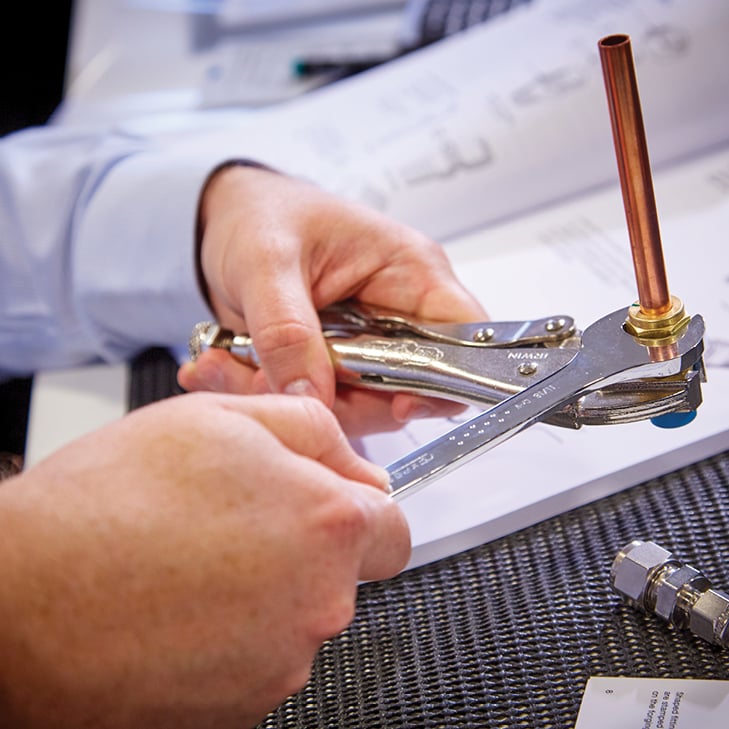
Closeup of associate that is tightening a fitting

Essentials Training

Teaches students foundational tube fitting knowledge and gives hands-on experience in order to minimize risk of leakage and ensure system integrity.

Upon course completion, students will know how to:

  • Properly select, cut, and deburr tubing.
  • Correctly assemble a Swagelok® tube fitting and gauge a tube fitting assembly.
  • Understand the differences in tube fitting designs, tube fitting components, and their importance to proper assembly.
  • Identify thread types and installation practices, and properly prepare threaded installations.

For fabricators and assemblers. May be of general interest to engineers.

Training Schedule →

Teaches students how to mitigate and minimize risk of leakage through proper inspection.

Upon course completion, students will be able to:

  • Identify correct tube system placement and correctly install Swagelok® tube fittings.
  • Identify mixed component fittings and the use of correct tubing type.
  • Point out common tube bending defects and how they impact a fluid system.
  • Demonstrate the correct use of thread tape.

For engineers, supervisors, and project managers.

Training Schedule →

More connections mean greater potential for leaks. The Swagelok Tube Bending Essentials course offers foundational knowledge and hands-on experience in order to introduce bent tubing to your system to eliminate connections and leak points found in traditional threaded pipe systems.

Upon course completion, students will be able to:

  • Explain three variables that must be considered when bending tube.
  • Explain the purpose of the straight tube length mark on the name plate.
  • Calculate the length of tube used in an offset given all necessary information required to make the calculation.
  • Describe springback, how it affects the bending process, and ways to compensate for it.
  • Explain minimum length of the last leg and describe how this length can be used.
  • Bend tubing into a shape as specified by a template using the Swagelok method of tube bending, bend data, and tube bender.
  • Identify the components of the Swagelok hand tube bender.
  • Explain the purpose of the three types of marks used in the Swagelok method of tube bending.
  • Identify five potential bend defects and explain their causes.

For fabricators and for engineers who need to understand tube bending in order to incorporate tubing in their design.

Training Schedule →

Consistent performance, especially in critical applications, is important to a successful system. This course offers foundational knowledge in cone and thread preparation and installation tailored to bring optimal performance to your medium or high pressure system.

Upon completion, students should be able to:

  • List safety precautions when using the coning and threading tools.
  • Describe medium and high pressure fittings and differentiate the components between the two.
  • Demonstrate the proper use of the coning and threading tool (including tube preparation, inspection, and maintenance).
  • Install cone and thread fittings, and perform basic troubleshooting.

For maintenance and technician associates at facilities using high pressure systems.

Training Schedule →

This course will help you understand and identify key design characteristics of medium-pressure Swagelok® FK series fittings and learn how to prepare and install them. It covers the basic criteria, variables, and considerations relevant to safely and effectively using FK tube fittings in up to 20 000 psi medium-pressure gas and liquid systems. 

Key topics include:

  • FK medium-pressure tube fitting 
  • Tube variables 
  • Tube preparation
  • Initial assembly
  • Disassembly and reassembly
  • Preswaging
  • Knowledge and practical exam 

For technicians, maintenance, and engineering personnel involved in the installation, maintenance, inspection, and design of medium-pressure tubing systems. 

Training Schedule →

The Swagelok VCR® metal gasket face seal fitting and VCO® O-ring face seal fitting provide leak-tight service in applications where clearance is an issue or components require frequent replacement or service. Learn the differences between VCR and VCO fittings, their common features and key markings, and where they are used in this course. Then, learn what it takes to install each fitting type effectively and how to troubleshoot any issues you encounter. 

Key topics include:

  • Applications 
  • Fitting components 
  • Design features  
  • Correct assembly  
  • Installation best practices  
  • Troubleshooting  

For technicians, maintenance, and engineering personnel involved in the installation, maintenance, inspection, and design of tubing systems. 

Training Schedule →

Extend your production cycle, ensure safety, and lower total cost of ownership by understanding the fundamentals of fluid system hose.

Upon course completion, students should be able to:

  • Define common terms pertaining to hoses.
  • Describe how to evaluate hose fit for purpose.
  • Discuss hose selection variables, list common practices when conducting hose inspections, and discuss best practices for preventative maintenance of hoses.

For maintenance, technician, engineering, and management associates.

Learn More

Training Schedule →

Additional Local Trainings

Safety is a key consideration when selecting, maintaining, or replacing valves.

Upon course completion, students should be able to:

  • Choose the right valves for your applications by identifying proper valve types and functions.
  • Understand key features and construction.
  • Identify common issues.

For engineers, maintenance associates, and researchers.

Training Schedule →

Regulator selection is a primary consideration when designing your fluid system. Learn how the right regulator for your application can help increase safety while improving efficiency, as well as regulator basics and how to identify and resolve common issues.

Upon course completion, students will be able to:

  • List common regulator components and explain terminology associated with regulators.
  • Identify key design and performance characteristics of a regulator.
  • Discuss the different types of regulators and their applications.
  • State key design considerations when including regulators in a fluid system.

Technical presentation for engineers, researchers, and project managers; practical presentation for fabricators, maintenance associates, and technicians.

Training Schedule →

Swagelok-Sponsored Training

Designing, engineering, installing, and maintaining a high-performance hydrogen tubing system for maximum safety and integrity means starting with the basics. This training program provides in-depth, comprehensive focus areas beginning with a foundational understanding of hydrogen and progressing through critical aspects such as materials science, installation, tube bending, and fitting technologies.

This hands-on training is ideal for installers, technicians, engineers, designers, QC/QA inspectors, and others responsible for designing, installing, maintaining, and/or inspecting tubing systems in hydrogen and small molecule gas delivery systems.

Training Schedule

Which Class is Right for Me?  

If you design, construct, operate, or maintain sampling systems, you know how important quality data are. Inaccuracy usually results from problems within the sampling system, not the analyzer. Our hands-on training helps you to diagnose and eliminate common sampling system design flaws, increasing your efficiency and saving you money. All classes are taught by industry experts, each with more than 30 years' experience. Completion of these courses will prepare you to design, maintain, or improve the performance of your process analyzer systems.  

SAMPLE SYSTEMS PROBLEM SOLVING AND MAINTENANCE (SSM), 2 days

For Maintenance Personnel, Reliability Personnel, Analytical System Engineers new to the use of sampling systems. 

Course Objectives

  • Gain a better understanding of sample system components, such as valves and regulators, and their roles within the system
  • Diagnose and troubleshoot sample system errors
  • Learn sample system maintenance techniques
  • Diagnose and fix time delay problems
  • Understand sample system performance
  • Learn why and how samples change phase and how to manage your systems to control it
  • Through hands-on exercises and learn projects using fluid system components such as regulators, apply course knowledge to solve real-life problems

PROCESS ANALYZER SAMPLING SYSTEMS (PASS), 5 days

For Analytical System Engineers, System Design Engineers, Instrumentation Engineers, Integrators, Chemists who may not be experienced in working with sampling systems.  

Course Objectives

  • Introduce the main components of an effective sampling system for process analyzers
  • Identify the three performance goals of a sampling system that must be achieved
  • Understand common reasons for less than optimal system performance
  • Calculate time delay in a sample system
  • Understand in detail how sample conditioning system devices work and learn the correct way to install them
  • Design effective sample transport and return lines
  • Learn the effects of phase change on the sampling system
  • Design and present a sampling system made up of components based on given process and environmental conditions

Here's what graduates of PASS training have to say:  

"Whether you're troubleshooting or building a sampling system, these classes can deliver what you need to succeed."

"The material we covered in this class should greatly improve our reliability in sampling systems and analyzers."

PASS-SUBSYSTEMS, 5 days*

For Analytical System Engineers, System Design Engineers, Instrumentation Engineers, Integrators experienced in working with sampling systems.  

Course Objectives

  • Identify the five subsystems that are common to all analyzer sampling systems
  • Explore different ways to set up the subsystems to optimize the overall system
  • Examine the functions that might be performed on the sample in each subsystem
  • Evaluate the design options available for performing subsystem functions
  • Improve subsystem component reliability through proper selection and use
  • Design and present a sampling system made up of components and sub-components optimized for performance

*No pre-requisite for PASS Subsystems is required, but prior completion of PASS training may be helpful.  

Training Schedule →

  • Basic welding principles and the fundamentals of orbital welding.
  • Hands-on, comprehensive review of orbital welding.
  • Equipment enables attendees to setup, operate, and troubleshoot equipment and critique weld quality.
  • Information regarding the Swagelok M200 power supply, weld heads, fixturing, and the tube facing tool.
  • Includes weld sample submission for ASME Section IX Weld qualification.

Learn More

Training Schedule →

  • How to set up and operate all three Swagelok tube benders.
  • Use of the Swagelok Method of Tube Bending to accurately locate and lay out multiple bends on straight tubing prior to bending.
  • Other topics include:
    • Single bends
    • Multiple bends
    • Making bends from both directions
    • Bend dimensioning (from blueprints)
    • Accurately positioning tubing for changes in plane
    • How to maintain equal spacing on parallel tubing runs
  • Applications require the attendees to bend tubing into precise shapes as specified on sketches, blueprints, as well as from actual measurements taken by the attendees from actual fluid system components. 

Training Schedule →

  • Overview of the properties of steam and steam systems.
  • Steam Basics 1 attendees learn critical areas of steam system management including steam cost calculations, flash steam, steam traps, and water hammer.
  • Other topics include steam fundamentals, steam quality, steam system components, flash steam recovery, and safety.
  • Steam Basics 2 expands on the topics included in Steam Basics 1. Includes review of Steam Basics 1, boilers, heat recovery, steam piping, condensate piping, expansion, and insulation.

Learn More

Training Schedule →

Customized for the industry and specifically designed to address the needs of process and plant engineers. Available courses:
  • Refinery and Chemical Steam System Reliability, Safety, and Optimization
  • Pharmaceutical Steam System Training
  • Pulp and Paper Steam System, Reliability, Safety, and Optimization
  • Food and Beverage Steam System Reliability, Safety, and Optimization 

Training Schedule →

  • Total System Reliability, Safety, and Optimization -- reviews all aspects of a steam system.
  • Provides a sold foundation of understanding a total steam system from steam generation through condensate recovery.
  • Steam Generation Equipment and Components -- focuses specifically on steam generation equipment (boilers) and associated components.
  • Attendees participate in groups of 2 or 3 and gain a thorough understanding of fundamentals of boiler plant design including accessory components (turbines, deaerators, etc.).  

Training Schedule →

  • Technical seminar that can be customized to meet local needs.
  • Addresses customer needs for material selection in customer applications with an emphasis on understanding and preventing corrosion.
  • High-value training for customers on materials and corrosion in typical customer applications.

Training Schedule →


maxresdefault-3
×

Stay ahead with hands-on training

Browse our upcoming training offerings to find the right course for you or your team and secure your spot. View the full schedule to plan your next training opportunity.

Training Questions? We’re Here to Help.


Have questions about our training program or interested in scheduling a session for your team? Our team is ready to help you find the right course and coordinate the details. Reach out to get started.